Exogenesis
A world of creatures that eat, breed, learn and die out, running in your browser and saved on your own device.
Classic rules is Conway's game of life, which used to live at this address. It is a mode inside the app now.
What it is
You seed a planet and let it run. Plants grow where the ground and the weather suit them, creatures are born with small evolved brains and have to work out how to eat, and the ones that manage it have young that start a little different. Nothing is scripted. Every creature is a body of a few cells with a mouth, a gut, eyes and movers, and a network behind them that learns while it is alive and passes on only what it was born with.
Left alone it goes somewhere. Lineages split, one of them gets good at something, a drought or a meteor arrives and undoes it, and eventually the world empties. When that happens the app tells you what killed it, with the numbers it is reading from. Then the plants carry on without anyone, and life can start again on its own.
The living world
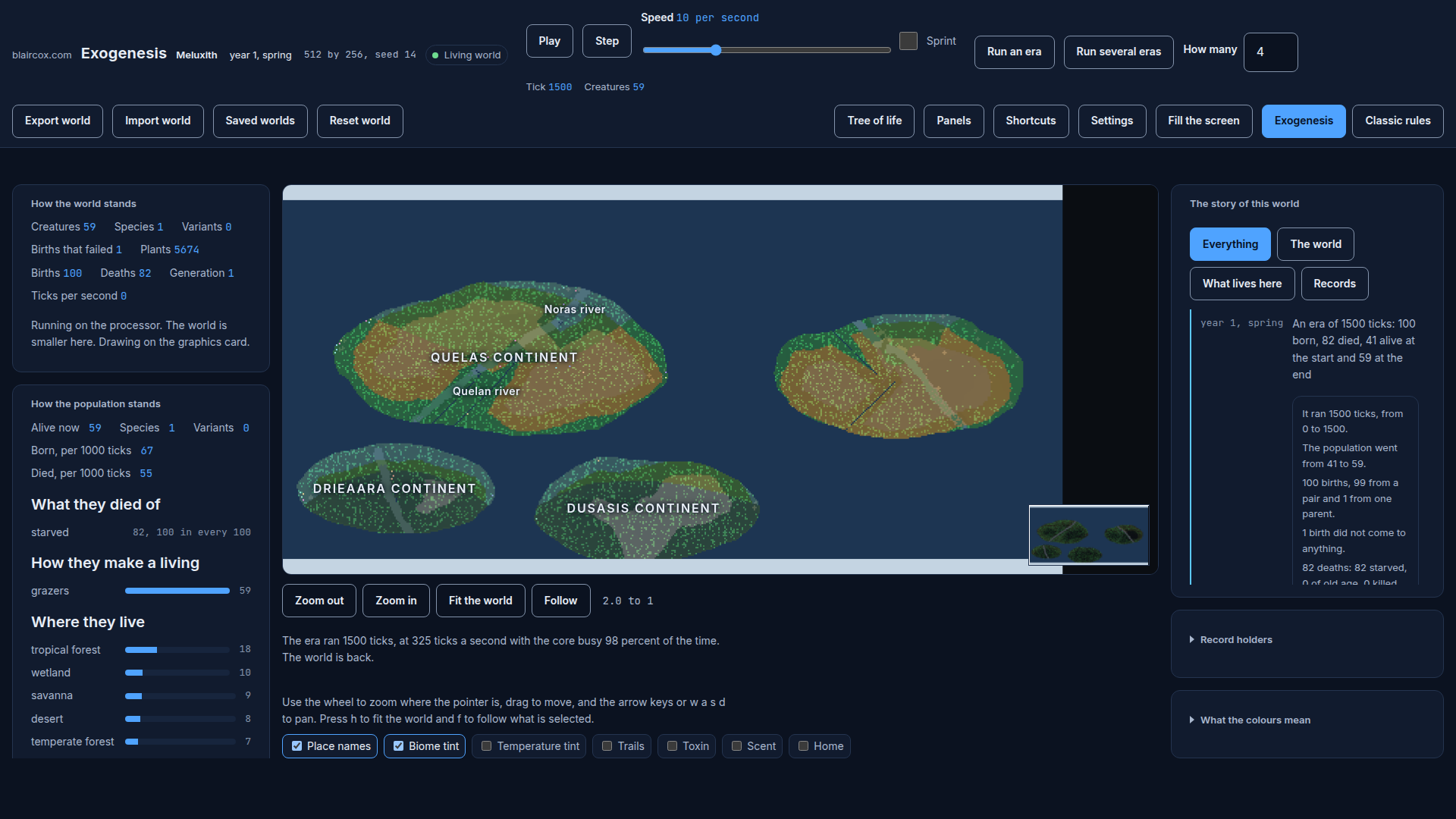
A globe, wrapped east to west through one ocean, with ice at both poles. Continents, rivers, mountains and nine biomes from tundra to tropical forest, each with its own fertility and its own plants. Regions get names. Zoom in far enough and the creatures stop being dots and become the bodies they actually are.
Evolved minds
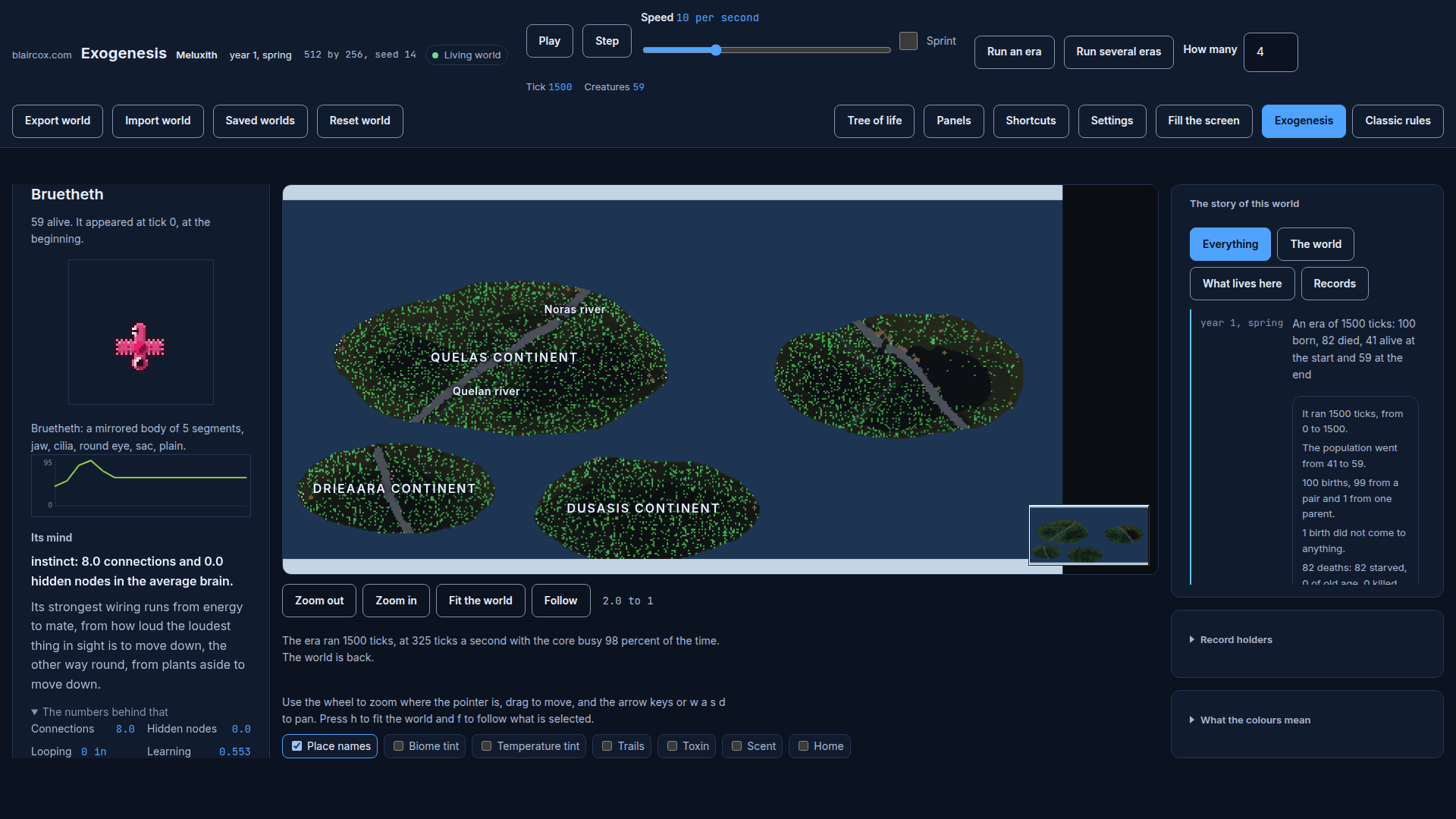
Every species can be opened up: what it looks like, how many of it there are, what it eats, what eats it, and what its brain is. The mind panel says in one sentence what a species has actually learned to do, and the numbers behind that sentence are one click away if you want them. Brains grow new connections and new nodes across generations, and each creature also learns within its own lifetime, which is never inherited.
The chronicle
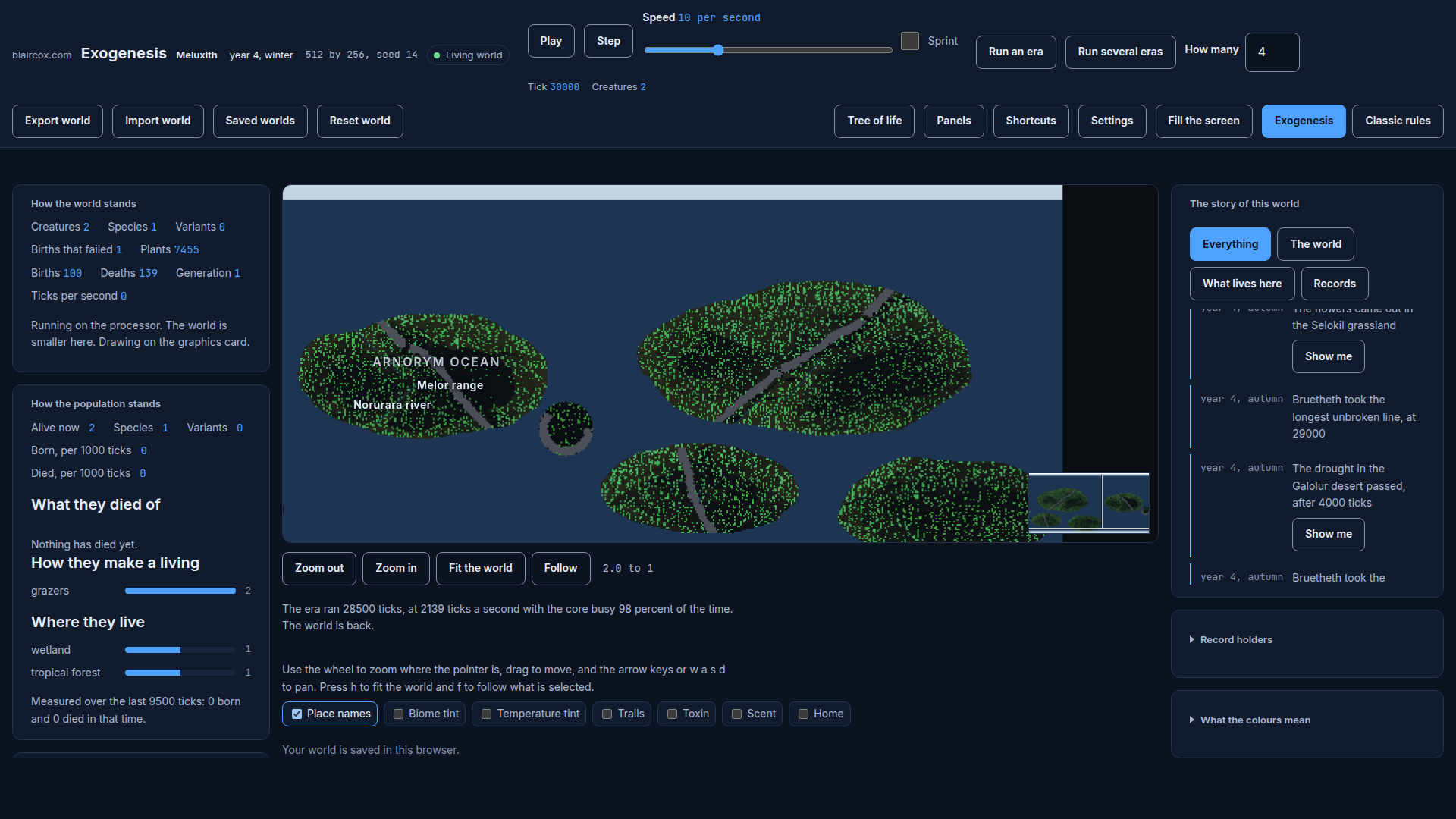
The world writes down what happens to it, in years and seasons rather than tick counts. A species appears, a lineage splits, a population booms or crashes, a drought settles over a desert and later passes, a record falls. Anything that happened somewhere has a button that flies the map to the spot. Run a few thousand years past in one go and the whole stretch comes back as one card telling you what it cost.
Death and rebirth
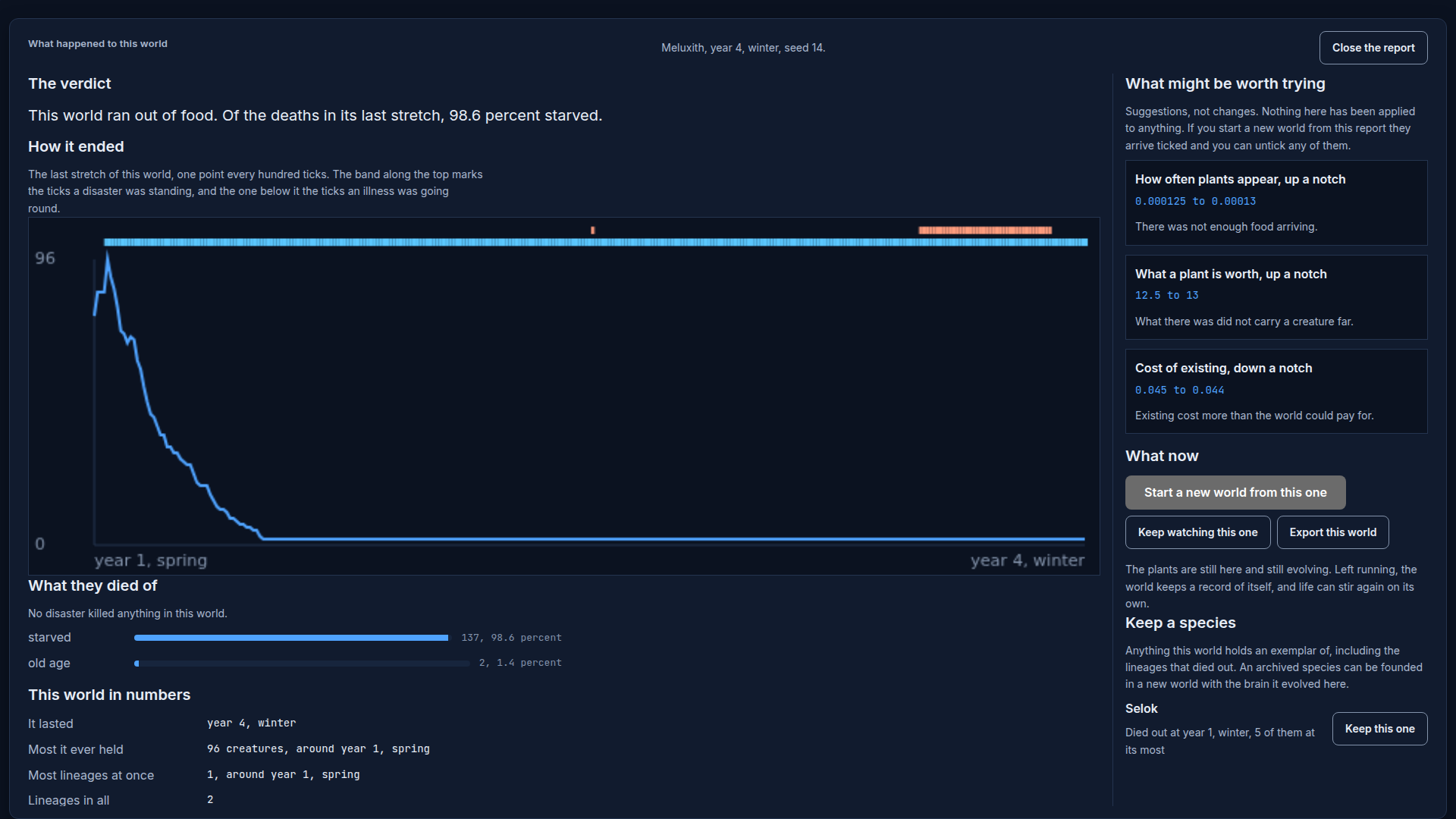
When the last creature dies the world stops and explains itself: a verdict, the curve of the ending, what everything died of, the world in numbers, and a few suggestions about what to change. Nothing is applied for you. You can start a new world carrying whichever suggestions you want, keep any species you liked in an archive and found it again with the brain it evolved, or simply keep watching. The plants are still there, and life can stir on its own.
How it works
-
Seed a world
Pick how much world you want and press on through, or move any of the sliders. It suggests a size for the machine you are on and never insists on it.
-
Let it run
Watch it at whatever speed suits, or run whole eras past with nothing drawn and read what happened afterwards.
-
Read the story
The chronicle, the charts, the species and the family tree all describe the same world. When it ends, the report says why.
Before you start
- It runs in your browser
- Nothing is installed and nothing is uploaded. The whole simulation runs on your machine.
- It saves on this device
- Worlds are kept in this browser, on this computer. Clearing your site data clears them, so export anything you want to keep. An exported world is a file you can bring back later or open on another machine.
- It is built for a desktop screen
- It works on a phone, with the panels folded into drawers, but there is a lot to look at and a big screen is a much better time. A world is as large as you ask for, and a large one asks a lot of the machine.
- Classic rules is still here
- Conway's game of life, the same page it always was, as a mode inside the app.